
 English
 Español
  Français
  Deutsch
  Татар теле
  Furlan
  Português
  العربية
  日本語
日本語  한국어
한국어 Backpack Unboxing Review and Buying Guide: How to Choose a Truly Child-Friendly, Spine-Supporting Backpack
Every school season, “how to choose a backpack” becomes a hot topic among parents. Backpacks on shelves range from dozens to thousands of yuan, with marketing slogans touting “spine protection,” “weight reduction,” and “ergonomics.” Yet the real difference never lies in price, but in tangible, measurable factors like weight and carrying structure. In this backpack buying guide, we take a hands-on approach based on actual unboxing tests to thoroughly explain how to make the right choice: first, we’ll show you why appearance alone isn’t enough when selecting a backpack; then, we’ll share five key dimensions we focus on during testing; finally, we’ll provide a four-step selection method and tips to avoid common pitfalls—helping you find a truly spine-supportive backpack that genuinely reduces your child’s burden.
Unboxing Test: We Focused on These 5 Key Dimensions
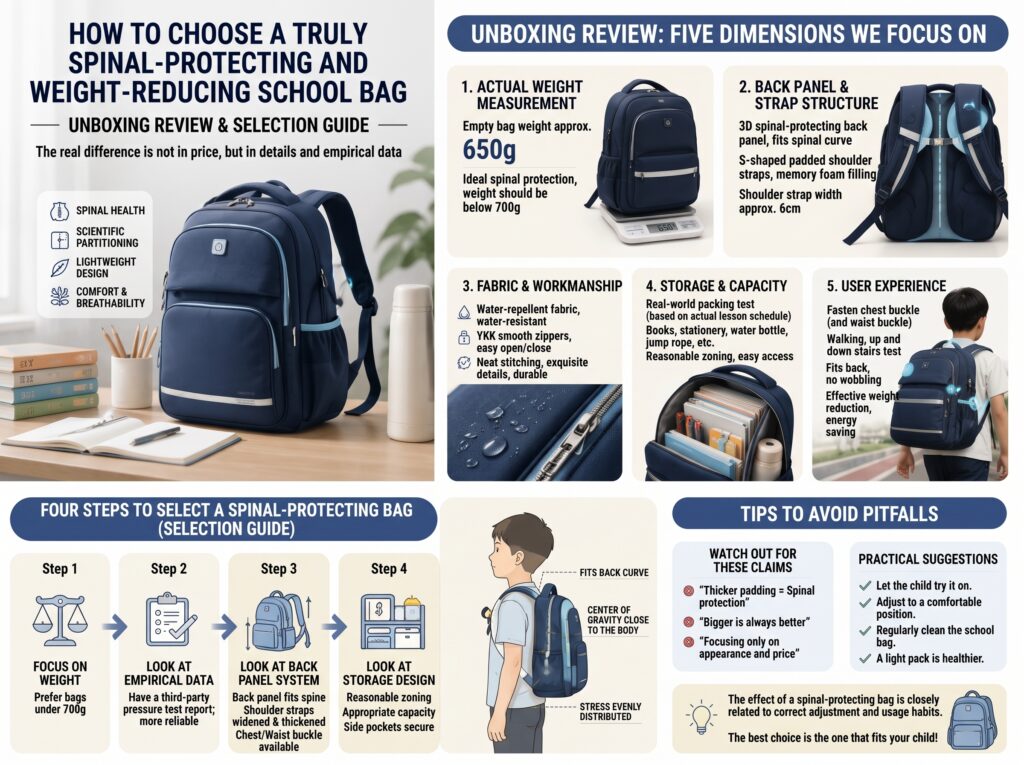
After receiving the [Product Brand + Model] back support backpack (reference price: [Price] yuan), we didn’t rush to draw conclusions. Instead, we carefully unboxed and tested it based on the following five dimensions—one method that works just as well when trying out backpacks in physical stores.
- Actual weight measurement: First weigh the empty package After removing all packaging and tags from the backpack, we weighed it empty and found its actual weight to be approximately [weight value] grams. According to current mainstream recommendations, the ideal weight for a posture-supporting backpack should be under 700g[4]. For every 100g reduction in weight, a child’s daily shoulder load is genuinely reduced by one unit. This is a crucial factor to check before purchasing any backpack—it’s often overlooked yet has the greatest impact on comfort and experience.
- Back panel and shoulder strap structure: feel with your hand, observe with your eyes The backpack features a back panel designed with [back panel description, e.g., “3D spine-supporting back panel with a central groove that avoids pressure on the spine”], offering a balanced firmness when pressed—hard enough to support books without deformation, yet soft enough with cushioning layers to prevent discomfort. The shoulder straps are [strap description, e.g., “S-shaped widened design filled with memory foam”], measuring approximately [shoulder strap width] cm in width. For reference, official guidelines recommend that backpack shoulder straps should be no narrower than 40 mm; straps that are too narrow can dig into the shoulders, while those that are too wide may cause slouching. [5]
- Fabric and Craftsmanship: Water-Repellent Test + Detail Inspection We poured a small amount of water on the surface of the backpack to observe its [water-repellent performance description]; we repeatedly pulled the zipper to evaluate the [zipper experience description]; and we carefully inspected the stitching, edges, corners, and hardware for [craftsmanship conclusion description]. These factors determine whether the backpack can withstand daily use over one or two years.
- Storage and Capacity: Pack according to the actual class schedule We packed the actual contents—such as Chinese, math, and English textbooks, workbooks, pencil case, 500ml water bottle, and jump rope—into the bag. The main compartment has [capacity description], and the side pocket securely holds the water bottle [stability description]. We recommend packing according to your child’s actual class schedule rather than estimating based on advertised volume capacity.
- Upper back experience: Fasten the chest and waist straps before walking two laps Have the child wear a backpack filled with books, fasten the chest strap [and mention waist strap if applicable], walk around for a few laps and climb one flight of stairs, then observe whether the backpack fits snugly against the back and whether there is any noticeable sagging at the rear. This model offers [description of upper back fit experience]. Please note: The effectiveness of spine protection is closely related to how well the backpack is adjusted to fit the child’s back; fit may vary depending on body type, so it’s essential to have the child try it on before purchasing. [6]
Four Steps to Choosing the Right Back Support Backpack (Buying Guide)
Based on unboxing tests and publicly available purchasing guides, we’ve condensed the method into four steps:
- Step 1: Check the weight. Prioritize backpacks weighing less than 700g to reduce the basic load from the start. [4]
- Step two: Check the actual test data. Products with third-party pressure test reports are more reliable than those relying on marketing claims like “thickened sponge”—focus particularly on the reduction in shoulder pressure under both static standing and dynamic walking scenarios. [4]
- Step 3: Examine the back support system. A qualified posture-supporting backpack typically features a contoured back panel (with a curved design that follows the natural spinal curvature and includes a groove or channel to avoid direct pressure on the spine), wide padded shoulder straps, and a chest strap (with an optional waist strap for younger students). The shoulder straps should be at least 40 mm wide, while the chest and waist straps should be adjustable in length to ensure three-dimensional pressure distribution across the shoulders, back, and waist. [3], [5]
- Step 4: Choose the size based on height. A backpack isn’t better just because it’s larger—size should match your height. Refer to the following guidelines: [7]
| Height range | Recommended backpack dimensions (height × length × width) |
| 166 cm and above | 42cm × 32cm × 16cm |
| 144 to 166 cm | 38cm × 30cm × 14cm |
| 128 to 144 cm | 33cm × 30cm × 12cm |
| 128 cm and below | 30cm × 28cm × 10cm |
Note: Additionally, children under 144 cm in height should preferably choose models equipped with waist and chest straps. [7]
These three pitfalls are the ones parents are most likely to fall into
- Pitfall 1: Focusing only on price, ignoring backpack structure. After testing, some parents remarked, “My child says the feel of a $30 bag is almost the same as a $1,000 one.” A higher price doesn’t necessarily mean better spine support—the key lies in practical factors like weight and ergonomic design. Conversely, even a low-cost backpack with poor construction isn’t recommended for carrying heavy loads over long periods. [8]
- Pitfall Two: Ignoring the backpack’s own weight. Some backpacks are feature-packed and look sturdy, but their empty weight can approach 1 kg—once loaded with books, it easily exceeds the 10% body weight threshold. Remember: the base weight is everything.
- Pitfall 3: Using a single-shoulder or crossbody bag to carry books for extended periods. Uneven weight distribution on one side can lead children to develop slouching and hunched postures. When carrying heavy items to school, always use a backpack and ensure both shoulder straps are properly worn with the chest strap fastened. [3]
Frequently Asked Questions (FAQ)
Are posture-supporting backpacks just a scam?
Not entirely, but you need to know how to choose. The term “spine protection” alone isn’t a guarantee. A backpack with a scientifically designed carrying structure—such as a three-dimensional back panel, wide shoulder straps, and chest clip for pressure distribution—can genuinely reduce strain on the shoulders. However, products that merely display “spine protection” on their packaging don’t necessarily deserve your money.
How often should a school bag be replaced?
It is generally recommended to inspect once per semester: whether the shoulder straps are loose or have lost elasticity, if the back panel has collapsed or deformed, and if the zipper is stiff or jammed. If any structural support shows obvious signs of aging, replacement is advised even if the exterior appears intact.
How can you tell if a child is carrying their backpack correctly?
Three signs:
- The bottom of the backpack should not be much higher than the waistline.
- The child’s body should not noticeably lean forward or backward when standing.
- They should not complain of shoulder pain or show deep pressure marks after walking a short distance.
Additionally, regularly checking whether the total weight of the backpack exceeds 10% of the child’s body weight is the simplest and most effective self-check method.